Indonesia's annual forest fires are shaping up to be one of the worst since the 2015 fires that choked Sumatra, Kalimantan and affecting neighboring countries as far as Cambodia and Vietnam.
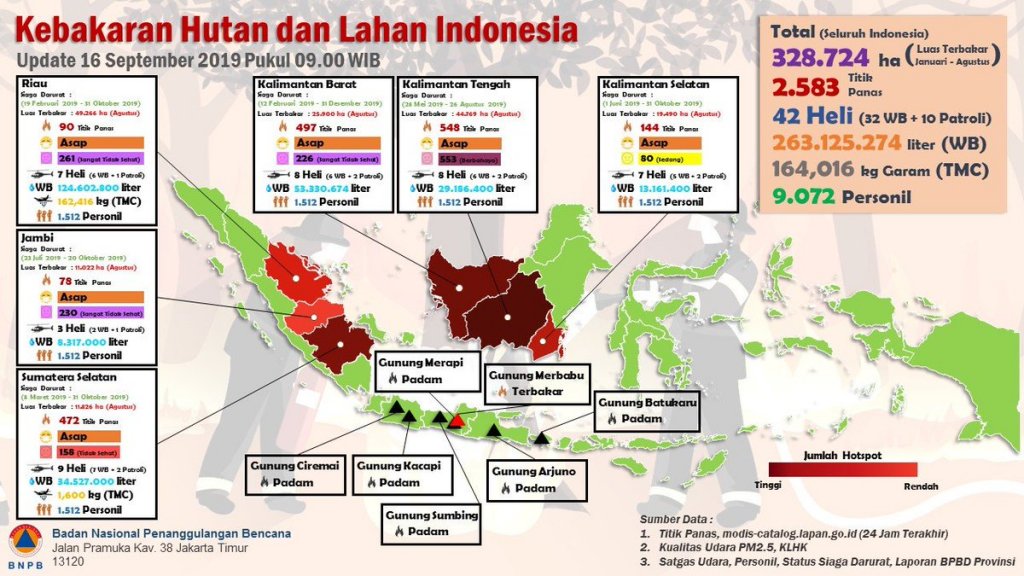
BNPB reported that on Sept 16, 2019 there are 2,583 hot spots recorded, and fires have burned 328,724 hectares.
Many major Indonesian cities are suffering from extremely unhealthy levels of air quality, with scenes that could have come straight from a horror movie.
Twitter user @RyaFairuz shared this view from Pontianak at 6 am this morning:
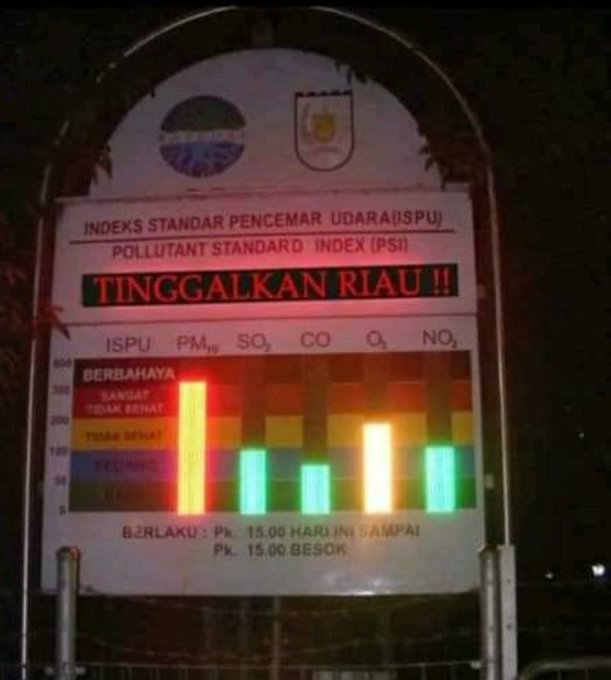
Meanwhile, the government installed pollution meter in Riau recommends that people evacuate the city:
Indeed, schools have been closed for a week and residents are urged to stay indoors in Riau and neighboring Jambi. Some deaths have been blamed on the fire as well, including a man trying to save his farm, firefighters, and most tragically, a 4 month old baby. The true death count, or the cost of this disaster may never be known.
The situation naturally drew ire from citizens all across Indonesia, particularly those in Sumatra and Kalimantan. Many accuse the government of ignoring their plight just because they are far from the capital. Netizens point out how Jokowi made a big show of berating PLN directors over a one day power outage that affected Jakarta, while being silent over the much bigger disaster of forest fire. "Indonesia is just Java", a frustrated Ahmad Syawqi wrote on Twitter, a sentiment that has been retweeted over 11 thousand times.
A particular tone deaf response from the government came from Moeldoko, a former Chief of the TNI, and current Chief-of-Staff to President Jokowi. On his Twitter account he quoted the Qu'ran and wrote that natural disasters come from God and should be accepted willingly.
While forest fires during the dry season is a natural phenomenon, it is greatly exacerbated by logging (both legal and illegal) and slash-and-burn agriculture. The later mostly practiced by palm oil plantations. In fact, as much as 80% of the burned down areas eventually become palm oil plantations, according to the National Disaster Mitigation Agency (BNPB).
The government is seen as unable or worse, unwilling, to act against companies that practice slash-and-burn. Along with coal, palm oil is Indonesia's number one export commodity. As long as this is true, it is unlikely that deforestation and all the disasters that come with it will ever be mitigated.
Meanwhile, for the millions of people affected in the region, the only relief in sight is the upcoming rainy season, which is expected late October, early November. A very long 6 weeks away.
BNPB reported that on Sept 16, 2019 there are 2,583 hot spots recorded, and fires have burned 328,724 hectares.
Many major Indonesian cities are suffering from extremely unhealthy levels of air quality, with scenes that could have come straight from a horror movie.
Twitter user @RyaFairuz shared this view from Pontianak at 6 am this morning:
Meanwhile, the government installed pollution meter in Riau recommends that people evacuate the city:
Indeed, schools have been closed for a week and residents are urged to stay indoors in Riau and neighboring Jambi. Some deaths have been blamed on the fire as well, including a man trying to save his farm, firefighters, and most tragically, a 4 month old baby. The true death count, or the cost of this disaster may never be known.
The situation naturally drew ire from citizens all across Indonesia, particularly those in Sumatra and Kalimantan. Many accuse the government of ignoring their plight just because they are far from the capital. Netizens point out how Jokowi made a big show of berating PLN directors over a one day power outage that affected Jakarta, while being silent over the much bigger disaster of forest fire. "Indonesia is just Java", a frustrated Ahmad Syawqi wrote on Twitter, a sentiment that has been retweeted over 11 thousand times.
A particular tone deaf response from the government came from Moeldoko, a former Chief of the TNI, and current Chief-of-Staff to President Jokowi. On his Twitter account he quoted the Qu'ran and wrote that natural disasters come from God and should be accepted willingly.
While forest fires during the dry season is a natural phenomenon, it is greatly exacerbated by logging (both legal and illegal) and slash-and-burn agriculture. The later mostly practiced by palm oil plantations. In fact, as much as 80% of the burned down areas eventually become palm oil plantations, according to the National Disaster Mitigation Agency (BNPB).
The government is seen as unable or worse, unwilling, to act against companies that practice slash-and-burn. Along with coal, palm oil is Indonesia's number one export commodity. As long as this is true, it is unlikely that deforestation and all the disasters that come with it will ever be mitigated.
Meanwhile, for the millions of people affected in the region, the only relief in sight is the upcoming rainy season, which is expected late October, early November. A very long 6 weeks away.