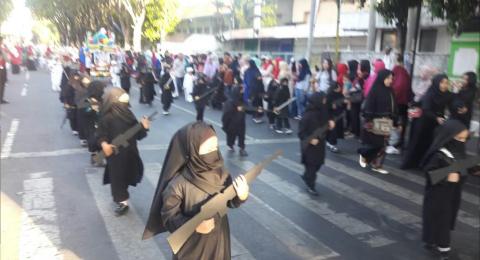
What are they teaching the kids here ? Probolingo Independence day

scouser59

Well-Known Member
Charter Member
Cager
Joined
Jul 17, 2016
Messages
640
48365-karnaval-siswa-siswi-taman-kanak-kanak-di-probolinggo-jawa-timur-facebook-ahmad-zainullah.jpg

Jeez ! anyone feel like an infidel ?

https://m.suara.com/news/2018/08/19...pala-sekolah?utm_source=LINE&utm_medium=News#!
 
Well the minister who flew down there himself said there was no radical aspect to it, so I guess all is ok... :tape:

Serious question; what does religion have to do with the Indonesian Independence struggle? Anyone got some links?
 
Well the minister who flew down there himself said there was no radical aspect to it, so I guess all is ok... :tape:

Serious question; what does religion have to do with the Indonesian Independence struggle? Anyone got some links?

Quite a lot. Darul Islam, and both NU and Masyumi declared that it was a Jihad. Bung Tomo was as much an Islamic preacher as an independence preacher as well

Doesn’t mean that the Nationalists and communists weren’t also involved, and at various times all fought each other. The islamicists at least had the good sense not to do so until the Dutch were out (many regarded the communists as traitors because they kicked off the Madiun uprising before the independence war was over)
 
Jakarta recently hosted the World Peace Forum where the Japanese speaker said the following......

"What are some of the lessons that Indonesia can learn from Japan in terms of creating peace?

From Japan, [I'm not sure if] this is a lesson or not, but one thing I'm quite sure of is that after the defeat of Japan in World War II, Japan made a very decisive decision to separate religion from government.

Before World War II, Japanese militarism utilized Japanese religion, especially the religion of Shinto, to promote the war effort, justify the goal of the war and so forth.

So, Japanese people were unable to face the freedom of Shintoism applied from above, by the government. Christianity and Buddhism were kind of pushed down by Shintoism. From that bitter experience, the Japanese constitution made it clear that religion should be separated from politics."


The full report from JP is here.....http://www.thejakartapost.com/news/...e-japan-separates-religion-from-politics.html

If only Indonesian Muslims could understand what he is saying......RI could benefit economically, socially and still have their religion, just as Japan did, after the devastation it suffered due to war. It is when the rabble want to use religion to implement politics and social change that there is conflict.
 
If only Indonesian Muslims could understand what he is saying......RI could benefit economically, socially and still have their religion, just as Japan did, after the devastation it suffered due to war. It is when the rabble want to use religion to implement politics and social change that there is conflict.

Disclaimer: I don't know anything about Japanese government and politics. While I think it would be a positive step for Indonesia to separate government from politics, I think it would quickly end up like the United States where the majority religion so strongly tied in with one side/party that at times it's virtually indistinguishable. It would still be an improvement, but political Islam would still be the dominant political force in RI.
 
Serious question; what does religion have to do with the Indonesian Independence struggle? Anyone got some links?

Many Dutch research papers on the role of Islam in the Independence. And also on the tri-pillar society model from Soekarno (Army, Communist, Islam).

This is an automated translation of an article by Marianne Boissevain in 1995:

Because the Dutch were wicked, every battle against them was automatically a holy war - the independence struggle of fifty years ago as well as the many wars of Islamic sultanates against the Dutch East India Company (VOC). Nevertheless, a separation of ideas soon emerged between the Islamic nobility, whose secular power depended on the approval of the Dutch, and the scribes, whose Islam schools (pesantren) often included anti-Dutch resistance.

Naturally, the Dutch tried to get Islam under control. They imposed all sorts of restrictions on Mecca-goers, and no hadji was ever appointed regent. From 1925, anyone who taught at an Islamic school had to apply for a permit, but no matter how intelligent their pupils were, who once attended an Islam school was never admitted to a public school. And still in the thirties there was no mosque in all of Batavia - they could only be built on the outskirts of the city.

At the end of the nineteenth century the Dutch Islam expert Snouck Hurgronje developed a dual Islam policy. First, the Muslims should not be hindered in the exercise of their religion - including the pilgrimage. Very sensible, because if you disturb a Muslim with his religious duties you will get real difficulties.

But secondly there are the social customs of Islam, such as paying the obligatory alms (zakat) and the meetings after the Friday prayer - you had to keep an eye on that according to Snouck. Because if they turned out to be political activities - and for a Muslim it is very difficult to separate religion and politics - then you had to suppress them.

Around the turn of the century Islam was regarded not only as a religion, but also as a nation. When Jakarta got its first cinema in 1910, it was classified in First Class, Second Class and Muslim Class - 'Muslim' was therefore a synonym for indigenous people. Two years later the first Islamic organization was established: the Sarekat Islam - and that was not only meant as an organization of Muslims, but also as an organization of the indigenous people. '

Although the Sarekat Islam was founded by a small group of Javanese merchants who wanted to join forces against the competition of the Chinese traders, the organization soon found an echo among Indonesians of all walks of life. Millions of town and country residents joined in protest against their cumbersome circumstances, increasing the influence of Marxists in the movement. Ultimately, the Sarekat Islam would languish to an internal battle between the supporters of Mecca and Moscow.

As the Sarekat Islam became more socialist, its role as an Islamic organization was gradually taken over by Muhammadiyah, which was also founded in 1912. This made a strong case for a modern Islam by setting up schools where not only Islamic but also modern, Western education was given and by keeping the Friday sermons in the vernacular.

The scribes felt threatened by the success of the modernist Muhammadiyah and founded the Nahdatul Ulama (the Awakening of the Scribes) in 1926. This orthodox organization competed with the Muhammadiyah in missionary zeal, with which she gained a lot of support in the countryside, especially in the long term. But both of them inspired the broad masses to resist colonial oppression.
 
yeah doesn't loss the job completely, which is what would happen anywhere else
 

Users who viewed this discussion (Total:0)

Follow Us

Latest Expat Indo Articles

Latest Tweets by Expat Indo

Latest Activity

Online Now

No members online now.

Newest Members

Forum Statistics

Threads
6,596
Messages
110,879
Members
3,881
Latest member
Fujifrankli
Back
Top Bottom